
If We Don’t Teach Them, the Algorithm Will
Screens are not the problem. Readiness is.

Screens: yes or no?
Phones: yes or no?
Technology: good or bad?
Maybe the better questions are:
When?
For what?
With whom?
And what is it doing to my child’s development?
Because the truth is… parents are not ready either.
We are the first generation raising children in this digital environment.
We did not grow up with smartphones in elementary school.
We did not grow up with algorithms learning our personalities.
We did not grow up with social media shaping identity before puberty.
But our kids are.
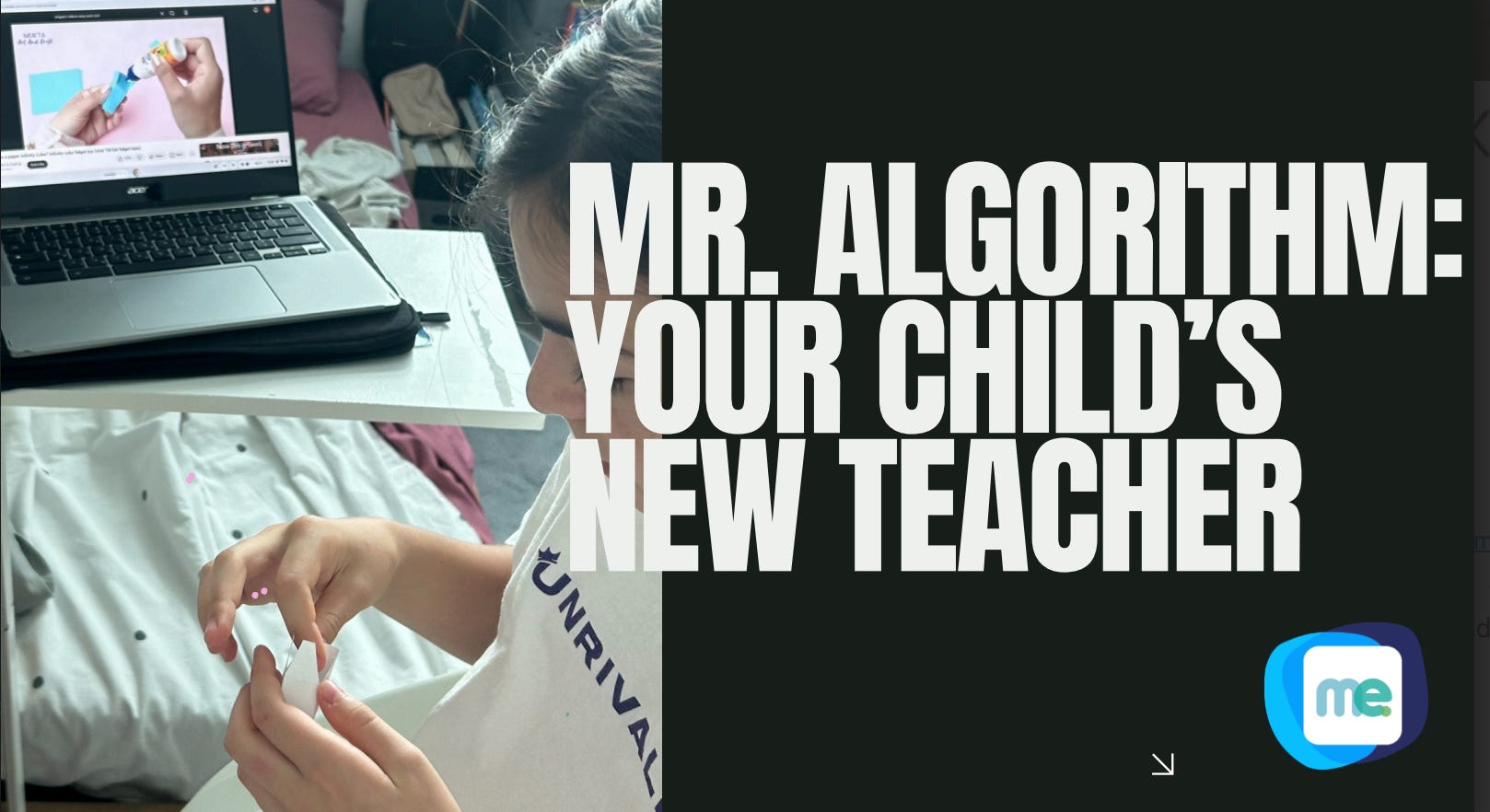
So when parents feel confused, strict, inconsistent, or even extreme, it makes sense.
We are trying to create rules for a world we are still learning ourselves.
So when parents say “no screens”… why?
Probably not because they reject technology.
After all, we use screens all day:
To work
To research
To compare information
To attend meetings
To write proposals
To review contracts
To send money
And even in ways we don’t always notice, like GPS.
We don’t memorize routes anymore.
We don’t get lost the same way.
We don’t build spatial awareness the same way.
A screen is now thinking for us in moments where we used to think for ourselves.
That matters.
So maybe what parents are reacting to is not screens themselves, but something deeper:
The quiet replacement of human skills.
Attention replaced by distraction
Boredom replaced by stimulation
Thinking replaced by shortcuts
Memory replaced by search
Orientation replaced by GPS
Conversation replaced by messaging
That concern is valid.
But the answer cannot simply be: “No screens.”
Not all screens are the same
We need to separate what we are actually talking about:
1. Screens for consumption
Scrolling, autoplay, fast content, passive intake.
2. Screens for creation
Writing, researching, building, designing, editing, coding.
3. Screens for social exposure
Social media, likes, comments, identity, comparison.
4. Screens for cognitive outsourcing
GPS, autocorrect, search, AI…. tools that think for us.
These are not equal.
A child creating a presentation is not the same as a child scrolling endlessly.
A student researching is not the same as a pre-teen managing social media.
Using GPS is not the same as learning how to navigate.
Yet we often group all of this under one word: screens.
Another layer: who is teaching our kids?
I studied communications.
Years learning how to analyze a film, how tone shapes emotion, when to cut, when to zoom, when to use silence, when to add music.
None of that is accidental.
Content is designed.
Today, anyone can create content.
Anyone can publish.
Anyone can reach millions.
But not everyone understands:
Child development
Emotional impact
Attention design
Ethical responsibility
So when we hand a device to a child, we are not just giving them access to information.
We are giving them access to:
Unregulated storytelling
Engineered attention loops
Emotional triggers they don’t yet understand
A child doesn’t see the editing.
They don’t see the intention.
They don’t see the manipulation.
They just feel it.
The real gap: literacy
We used to train a few people to create media.
Now children consume media before they can understand it.
That’s the gap.
Not access.
Understanding.
So the role of parents and schools shifts.
From controlling content…
to teaching interpretation.
From banning screens…
to building awareness.
What we can do (especially with younger kids)
For children who are not teens yet, we still have something incredibly valuable:
Time to teach.
Before exposure, we build foundations.
1. Mentoring (don’t just monitor)
Sit with them. Watch together. Ask questions.
“Why do you think this video feels so fast?”
“Do you think this is real or edited?”
You are building judgment.
2. Sleep (protect the brain)
No devices in bedrooms.
Screens off before bed.
Tired brains don’t regulate or learn.
3. Content (curate, don’t just block)
Choose slower, richer, more intentional content.
Repeat good content. Depth matters more than novelty.
4. Digital literacy (start early)
Explain simply:
“Algorithms show you more of what keeps you watching.”
“People online are trying to influence you.”
“Not everything you see is real.”
This is not technical education.
This is psychological preparation.
What schools can do
Schools should not blindly add screens.
And they should not completely remove them.
They should teach the difference.
No personal phones during the school day
Intentional, limited screen use
More creation than consumption
No addictive platforms as tools
Teach how tools work (including GPS, search, AI)
Teach the human skills alongside them
Because the goal is not dependence.
It is awareness + capability.
So,
Parents asking for “no screens” are not wrong.
They are trying to protect something they feel is slipping.
But protection is not only removal.
Protection is preparation.
Because eventually, kids will have:
Phones
Social media
GPS
AI
Unlimited content
The difference will not be access.
It will be whether they can:
Think without it
Question it
Use it intentionally
And recognize when it is shaping them
If we don’t teach them,
the algorithm will.
And it already is.